
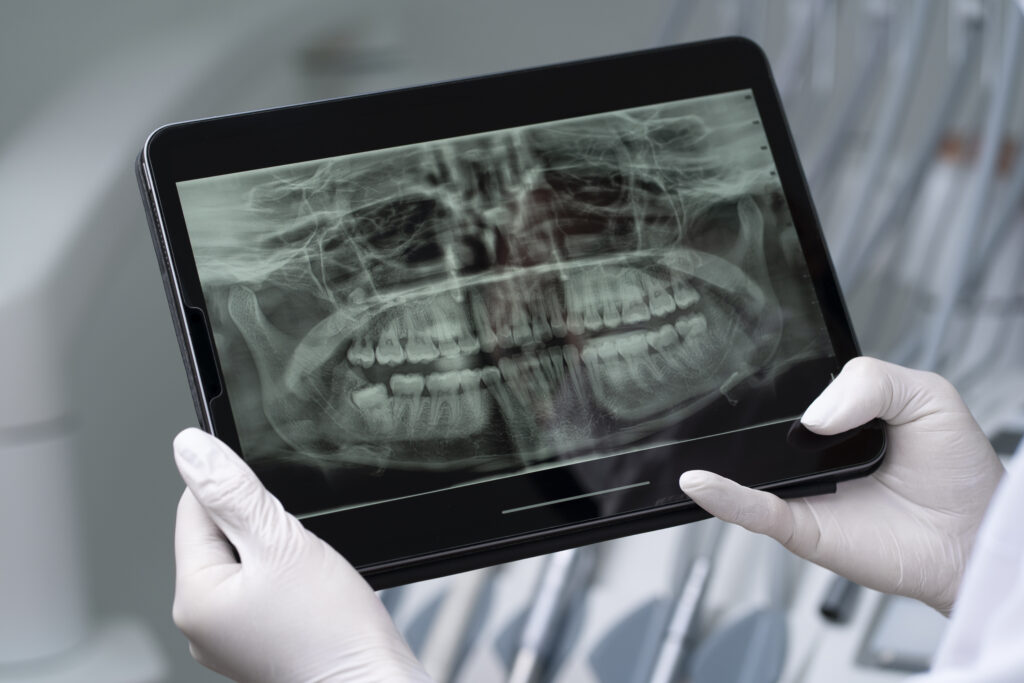
Detaillierte Darstellung
Doctorate from the Faculty of Dentistry - Damascus University
The Faculty of Dentistry at Damascus University certifies that the student Dr. Tammam Mohammad Saqr, Syrian national, born on 24.03.1979 in Latakia, has completed his two-year postgraduate study in the field of Oral, Maxillofacial and Facial Surgery from 2002 to 2004 with an overall grade "Very Good" with graduation decision No. 334 dated 11.10.2004.
In the years 2005 – 2007 he was enrolled in the Master's program in Dentistry with specialization in Oral and Maxillofacial Surgery at the Faculty of Dentistry of Damascus University. His thesis with the title "The Use of Water-containing Calcium Phosphate Cement without Guided Membranes in Dental Implantation" was prepared under the supervision of Professor Dr. Issam Khouri and included the following nine chapters:
Thesis Contents
Introduction and Research Objectives
Theoretical Review
- 2-1 Bone Grafts and Bone Substitute Materials
- 2-1-2 Classification of Bone Grafts
- 2-1-2 Ideal Specifications of Bone Substitute Material
- 2-2 Dental Implantation and Bone Grafting
- 2-2-1 Immediate Implantation
- 2-2-2 Late Dental Implantation
- 2-2-3 Staged Dental Implantation
- 2-2-4 Indications and Contraindications for Dental Implants
- 2-3 Guided Tissue Regeneration (GTR) and Guided Bone Regeneration (GBR)
- 2-4 Bone Augmentation
- 2-4-1 Bone Augmentation in Immediate Implantations
- 2-4-2 Bone Augmentation in Staged Dental Implantation
- 2-4-3 Complications of Bone Augmentation
- 2-4-4 Long-term Results of Implants with Bone Augmentation
- 2-5 Calcium Phosphate Cement
- 2-5-1 Classification of Calcium Phosphate Cements
- 2-5-2 Advantages and Disadvantages of Calcium Phosphate Cements
- 2-5-3 Filling Materials
- 2-5-4 Calcium Phosphate Cement in Medical Literature
- 2-6 Hydraulic Calcium Phosphate Cement
- 2-6-1 Features and Properties of Hydraulic Calcium Phosphate Cement
- 2-6-2 Theoretical Review of Hydraulic Calcium Phosphate Cement in Medical Literature
Materials and Research Methods
- 3-1 The Experimental Part
- 3-1-1 The Sample
- 3-1-2 The Materials Used in the Experimental Research Attempt
- 3-1-3 Questionnaire for Experimental Research Experiment
- 3-1-4 Surgical Technique
- 3-1-5 Sample Collection and Preparation Technique
- 3-1-6 Pathological Anatomical Tissue Examination
- 3-1-7 Standards Used in the Experimental Examination
- 3-2 Clinical Part
- 3-2-1 Research Sample
- 3-2-2 Clinical Study Materials
- 3-2-3 Questionnaire for Clinical Examination
- 3-2-4 Surgical Technique
- 3-2-5 Clinical Study Criteria
Results
- 4-1 Experimental Results
- 4-1-1 Results of Clinical Evaluation of Surgical Procedures on Experimental Animals
- 4-1-2 Results of Pathological Anatomical Tissue Examination
- 4-1-3 Results of the Statistical Study
- 4-2 Results of Clinical Study
- 4-2-1 Results of Clinical Evaluation of Surgical Procedures on Patients
- 4-2-2 Results of the Statistical Study
Presentation of Clinical Cases of Some Patients
Discussion
Conclusions and Recommendations
Summary in Arabic and English
References in Arabic and English
Research Summary
Introduction:
Fillers are used in dental implant operations as a solution for many dental implantation problems, particularly in cases where the amount of bone around the implant is small or insufficient to cover the entire implant surface. This occurs especially in cases of immediate implantation, that is, immediately after tooth extraction, where the conical shape of the alveolar pit often does not provide complete bone support for the implant surface. In cases of temporary dental implants, bone augmentation is often required to cover the entire implant surface from the palatal or lingual side.
Therefore, it was necessary to supplement the use of guided bone regeneration techniques with membranes combined with the application of such fillers, due to their physicochemical properties, to achieve a more natural approach to bone healing. However, many problems arose with this method, which often could not be resolved, including: The difficulty in closing the gap by the surgeon when a large amount of filler is applied and then the membrane is placed over it, as well as the unstable placement of most fillers despite guided membranes under the pressures present in the mouth. The difficulty in controlling the bone filler in place was also an important factor, as were the increased costs due to the application of bone filler and guided membrane over it.
All these difficulties that were previously mentioned and others prompted us to search for a solution that would allow us to dispense with the use of guided membranes when using bone augmentations around the implant. The choice fell on a commercially available material called PD Vitaloss, a water-containing calcium phosphate cement, which we expect to be able to achieve our desired results through its specific properties.
Research Objectives:
- Clinical evaluation of an injectable water-containing calcium phosphate cement applied to the rabbit mandible, after sacrificing the rabbits.
- Study of biological integration of an injectable water-containing calcium phosphate cement with host bone and histological tissue recognition and comparison of the healing process with natural healing approach.
- Application of an injectable water-containing calcium phosphate cement in humans for bone augmentation in both immediate and temporary implants without the use of guided membranes, in both one-stage and two-stage implants, and evaluation until gingival healing.
Materials and Research Methods:
Experimental Study:
- Twenty bilateral bone defects were created in the mandible of ten purebred rabbits.
- Ten bone defects were filled with injectable water-containing calcium phosphate cement, while the corresponding defects remained untreated to heal naturally.
- The rabbits were sacrificed after (2, 4, 6, 8, 12) weeks.
Clinical Study in Humans:
- Thirty implants (one-stage or two-stage) were placed in 12 patients in the jaw and classified according to implant type (immediate or temporary).
- Injectable water-containing calcium phosphate cement was applied around immediate implants and on exposed surfaces of temporary implants.
- The implants were tested after (2, 4) weeks and before gingival sculpting application.
Results:
1. Experimental Study Results:
- The ten bone defects filled with injectable water-containing calcium phosphate cement showed complete clinical bone filling during the previously mentioned time periods.
- The ten bone defects filled with injectable water-containing calcium phosphate cement showed rapid absorption rates of the injected material, which began within two weeks and were completed after 12 weeks.
- The ten bone defects filled with injectable water-containing calcium phosphate cement showed different rates of new bone formation, with average values between (14.5% after two weeks and 95.5% after 12 weeks).
- The ten bone defects left for natural healing showed different degrees of clinical filling, with the highest values not reaching 100%.
- The bone defects left for natural healing showed different rates of new bone formation, with the highest not exceeding 42% of the bone defect volume.
2. Clinical Study Results:
- Of the total 30 implants, 27 were successful, corresponding to a success rate of 90%.
- The success is distributed according to the implantation method as follows: 90% for both immediate and delayed implantations. Regarding implant type, the success rate is 75.7% for one-stage implants and 91.3% for two-stage implants.
Conclusion:
- Injectable water-containing calcium phosphate cement is considered a biocompatible material and a new generation of bone fillers that possesses the properties of guided bone materials while also having bone-forming properties.
- The use of injectable water-containing calcium phosphate cement to fill small bone defects is safe and uncomplicated, without the need for guided membranes, due to its stability at the injection site.
- Safe application of injectable water-containing calcium phosphate cement is possible in both immediate and temporary dental implantations, with a preference for two-stage implants.
- To achieve good results, the following measures should be taken after material application:
- Ensure good sealing of the injection site after material application.
- Keep the injected substance as far as possible from stress areas and areas with high pressure loads.
Based on the above, the Faculty of Dentistry of Damascus University certifies that student Dr. Tammam Mohammad Saqr, after two years of intensive work, has successfully defended his master's thesis. The work comprises 190 pages and was defended before a panel of renowned professors from the Department of Oral and Maxillofacial Surgery of the University. This occurred in 2007, and he graduated with distinction, based on the decision of the examination committee with decision number 1601 dated 15.05.2007. Thereby he has acquired the right to this final grade and its privileges, and upon his request, this certificate is issued to him.
Respectfully,
Damascus, 04.03.2024
Supervisor
Oral and Maxillofacial Surgery
Prof. Dr. Issam Alkhouri
Department Director
Oral and Maxillofacial Surgery
Prof. Dr. Hassan Jaafu
Dean of Faculty of Dentistry
Prof. Dr. Khaldoon Mohammad Atef Darwish